


Get in touch with us at sales@ultraaqua.com or use the form below. We will get back to you within 24 hours.
More than half of Denmark’s abstraction wells are affected by pesticides and their breakdown products, and in over 12% the concentration exceeds the drinking water limit. The most widespread metabolite, N,N-dimethylsulfamide (DMS), is found in 32% of Danish water supply wells and cannot be removed effectively with conventional activated carbon filtration.
Where DMS originates from local point sources, the DMS flux can be remediated at the source to protect the groundwater resource. In 2025, a Danish regional authority launched a pilot project at a DMS hotspot upstream of a drinking water well field to find a treatment method for the contaminated groundwater.
The project required high DMS removal, as concentrations at the hotspot are far above typical waterworks levels, while the groundwater quality criterion for individual pesticides is 0.1 µg/L. Oxidation by-products also had to be assessed, as the treated water was to be discharged.
UV-based advanced oxidation (AOP) can break down DMS effectively, but the most energy-efficient configuration depends on the water matrix. The pilot also had to provide a solid basis for full-scale design. This called for a UV/hydrogen peroxide (UV/H₂O₂) pilot that could compare lamp technologies on site.
ULTRAAQUA supplied an AOP test trailer with a vacuum UV (VUV) reactor, a medium-pressure UV (MP) reactor and H₂O₂ dosing, installed between the site’s sand filtration and activated carbon filters. The pilot built on an earlier VUDP-funded Danish water sector project, in which ULTRAAQUA, HOFOR, NOVAFOS and DTU Sustain showed that VUV alone can break down DMS, but only at a high energy input.
This pilot therefore added H₂O₂: UV light splits it into hydroxyl radicals that oxidize DMS, while VUV lamps add a second pathway by forming radicals directly from the water at 185 nm. With H₂O₂, DMS removal rose markedly for both lamp technologies, and for this water matrix VUV/H₂O₂ proved more than twice as energy-efficient as MP/H₂O₂.
In the final trials, VUV/H₂O₂ removed DMS to below the detection limit. The trials also showed that UV energy and H₂O₂ dose can be traded against each other, so the process can be optimized for the lowest operating cost. Nearly three months of long-term operation demonstrated high DMS removal. ULTRAWIPER™ lamp cleaning limited limescale build-up on the lamps and kept UV intensity from falling below a stable level. Residual H₂O₂ and the oxidation by-products formed were generally removed in the downstream activated carbon filters, and no bromate was detected.
The pilot identified VUV/H₂O₂ as the recommended method for the site and provided the data needed to design a full-scale plant. This reflects ULTRAAQUA’s approach of selecting the lamp technology for each water matrix in UV/H₂O₂ treatment.


High-capacity UV system for large-scale municipal drinking water treatment.
Learn more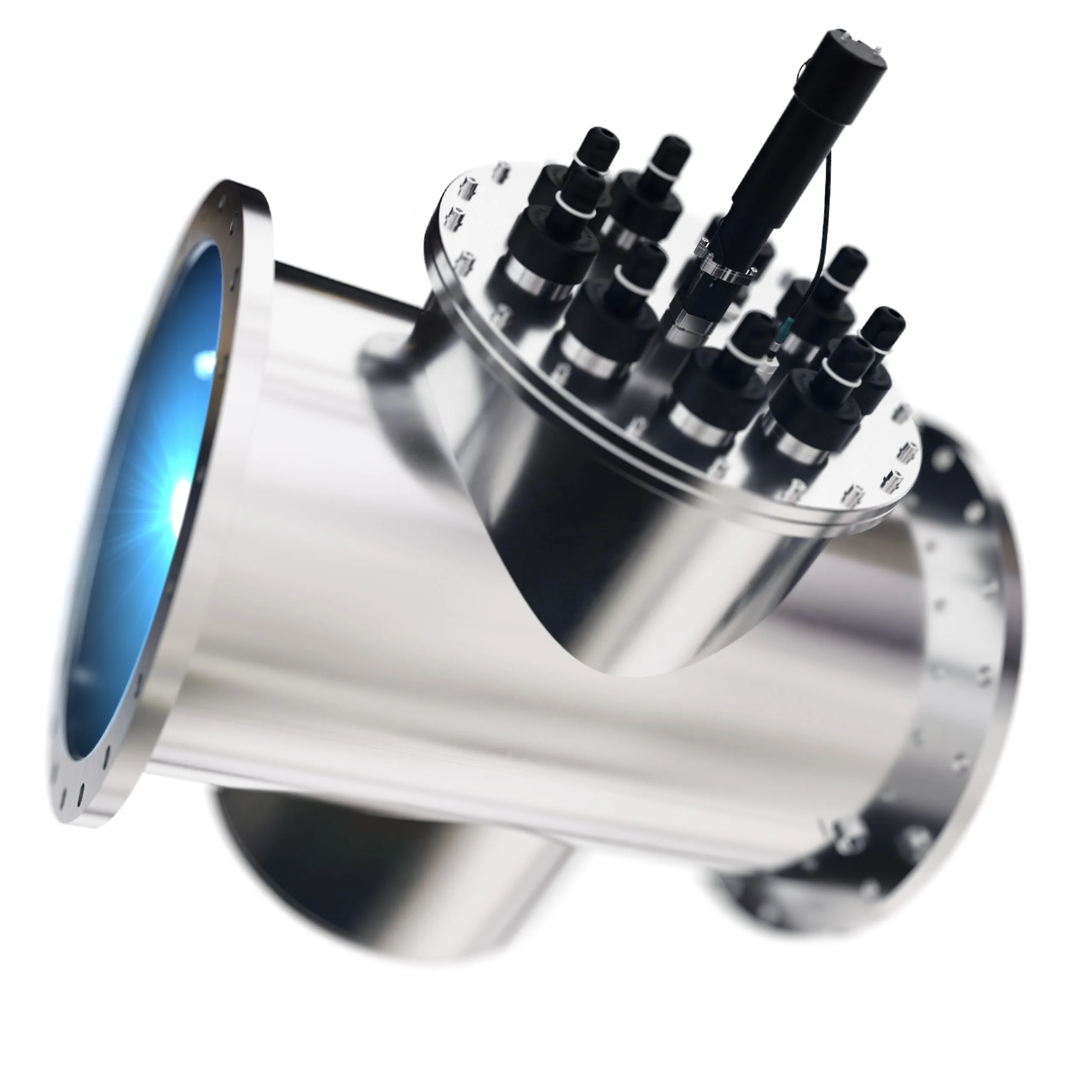
High-intensity UV disinfection with a compact design for high-flow applications.
Learn moreGet in touch with us here. We strive to get back within 24 hours on all inquiries.

ULTRAAQUA is an international manufacturer of UV & Ozone water treatment systems for a wide range of water treatment applications.
© Copyright – All Rights Reserved – Privacy Policy
Please provide your details below to request acccess to the ULTRAAQUA Partner System. We will get back to you shortly.

