
ABOUT AOP TECHNOLOGY
WHAT IS ADVANCED OXIDATION PROCESS (AOP)?
Advanced Oxidation Processes (AOP) are among the most powerful categories of water treatment technology available today. While standard disinfection inactivates bacteria and viruses, AOP goes further by targeting persistent chemical compounds, micropollutants, and trace contaminants that conventional treatment may not reliably remove or degrade.
The principle behind AOP is the generation of highly reactive hydroxyl radicals (·OH) in the water. These radicals are among the strongest oxidizing agents known, capable of breaking down even highly persistent organic molecules, including pesticides, pharmaceuticals, industrial chemicals, and taste-and-odor compounds, primarily into CO₂, water, and inorganic salts.
AOP is typically deployed as a final polishing step, following primary disinfection, to ensure water meets the most stringent quality standards. The technology typically combines two or more oxidation mechanisms, such as UV light with hydrogen peroxide, ozone, or both, to maximize radical generation and treatment efficiency.
As water scarcity intensifies globally and regulatory thresholds for micropollutants continue to tighten, AOP has become an increasingly important tool for municipalities, industrial facilities, and aquaculture operations seeking reliable, long-term water quality assurance.
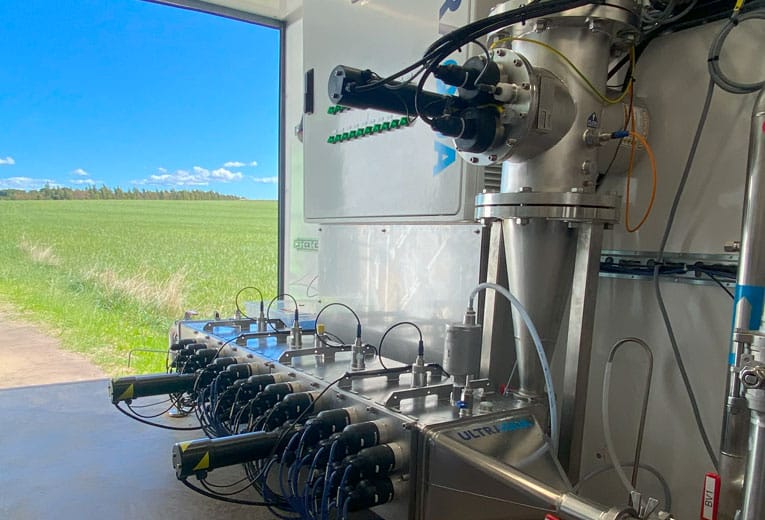
AOP BENEFITS
THE BENEFITS OF AOP SYSTEMS
Where standard UV or ozone treatment reaches its limits, AOP begins. By generating hydroxyl radicals with an oxidation potential substantially more effective than chlorine, AOP systems are capable of degrading certain persistent contaminants that no other single-technology approach can reliably eliminate at full scale.
When the oxidation process runs to completion, AOP produces CO₂, water, and inorganic salts, with no persistent chemical residue introduced into the treated water. This makes AOP particularly valuable in applications where water quality must be maintained at the highest possible level, such as ultrapure water production, food and beverage processing, and drinking water treatment.
Because each AOP combination can be selected and optimized for the specific contaminants and water matrix at hand, the technology delivers a level of precision and flexibility suited to a wide range of treatment challenges. A single system can be configured to address micropollutant removal, taste and odor control, TOC reduction, and microbial inactivation.
AOP SOLUTION OVERVIEW
ULTRAAQUA provides customized AOP solutions to accommodate virtually any water treatment challenge. The selection of the right AOP combination depends on the specific contaminants, pH conditions, UV transmittance, and water matrix. The six primary AOP configurations ULTRAAQUA deploys are seen below.
Please get in touch with us if you have any questions about your specific water treatment challenge.

UV/PEROXIDE
UV/PEROXIDE
Hydrogen peroxide absorbs UV light across the 200–300 nm range, triggering homolytic photolysis into hydroxyl radicals for contaminant degradation. Preferred over UV/Chlorine when water pH is in the slightly acidic to neutral range. UV lamp selection depends on water characteristics.
UV/PERSULFATE
UV/PERSULFATE
UV irradiation activates persulfate to generate sulfate radicals — more selective than hydroxyl radicals and particularly effective against electron-deficient contaminants and nitrogen-containing compounds like urea. Most efficient at acidic to neutral pH (5–7), as alkaline conditions promote conversion to weaker radical species. Typically uses low-pressure UV lamp technology.
UV/CHLORINE
UV/CHLORINE
UV irradiation photolyzes chlorine species across the 200–300 nm range, generating both hydroxyl and chlorine radicals for contaminant degradation. Most effective at neutral to slightly alkaline pH, where chlorine radicals enhance oxidation selectivity. UV lamp selection depends on water characteristics.
OZONE/PEROXIDE
OZONE/PEROXIDE
Hydrogen peroxide is added to accelerate ozone decomposition into hydroxyl radicals, enhancing conventional ozone oxidation. Hydroxyl radical production is maximized at neutral to slightly alkaline pH. Typically chosen for waters with low UV transmittance, where UV-based AOP processes are less feasible.
OZONE/VUV
OZONE/VUV
Ozone is dosed prior to the Vacuum-UV reactor to selectively oxidize background dissolved organic matter, reducing competition for OH-radicals and improving removal efficiency in the subsequent VUV-AOP step. Applied to enhance overall VUV-AOP performance in complex water matrices.
VACUUM-UV
VACUUM-UV
High-energy 185 nm UV light directly photolyzes water molecules, generating hydroxyl radicals without chemical additives. Highly effective for broad-spectrum oxidation and TOC removal in ultrapure water production. High energy consumption and limited VUV-light penetration depth require optimized reactor designs for large-scale applications.
Frequently Asked Questions
Your guide to AOP technology
As the presence of micropollutants, persistent chemicals, and trace contaminants in water sources continues to grow, Advanced Oxidation Processes have moved from being a specialist application to a mainstream water treatment solution.
The technology is increasingly being adopted across municipal, industrial, and aquaculture sectors worldwide, driven by tightening regulations, rising water reuse demands, and the need to address contaminants that conventional treatment cannot handle. In the guide below, you can find answers regarding how AOP works, which process fits your application, its benefits, and more.
What is Advanced Oxidation Process (AOP), and how does it differ from standard UV disinfection?
Standard UV disinfection works by delivering germicidal UV light that inactivates bacteria and viruses – it disrupts their DNA and prevents reproduction. AOP goes a step further. By combining UV light with an oxidizing agent such as hydrogen peroxide, ozone, or persulfate, AOP generates highly reactive hydroxyl radicals (·OH) in the water.
These radicals are among the strongest oxidizing agents known, and they break down complex chemical contaminants that UV alone cannot address. Where UV disinfection handles biological threats, AOP handles chemical ones: pesticides, pharmaceuticals, industrial compounds, taste-and-odor molecules, and more.
What types of contaminants can AOP remove?
AOP is particularly effective against persistent organic compounds that resist conventional biological and chemical treatment. This includes pesticides and herbicides in groundwater, pharmaceutical residues and endocrine-disrupting compounds, taste-and-odor compounds such as Geosmin and MIB, nitrosamines like NDMA, industrial solvents such as 1,4-dioxane, and Total Organic Carbon (TOC) in high-purity water applications.
For contaminants like NDMA and 1,4-dioxane, UV-based AOP is currently the most widely proven treatment method at full scale.
How do I know which AOP process is right for my application?
The right AOP combination depends on several factors: the specific contaminants and their concentrations, the UV transmittance (UVT) of the water, the pH, and the required treatment targets. As a general guide, UV/Peroxide works well at neutral to slightly acidic pH; UV/Persulfate is preferred for nitrogen-containing compounds like urea; UV/Chlorine is most effective at neutral to slightly alkaline pH; and Ozone/Peroxide is the preferred choice when UVT is low and UV-based processes are less feasible.
ULTRAAQUA uses advanced CFD modeling and, where needed, empirical pilot testing in our in-house laboratory to determine the optimal configuration for your specific water matrix before recommending a solution.
Is AOP a chemical-free process?
It depends on the AOP configuration. UV/Peroxide, UV/Chlorine, and UV/Persulfate processes require the addition of a chemical oxidant, which is photolyzed by UV light to generate hydroxyl radicals. In practice, oxidants are often dosed slightly above stoichiometric requirements to ensure sufficient radical generation, meaning residual oxidant may be present downstream and should be accounted for in the system design.
The exception is Vacuum-UV (VUV) AOP, which photolyzes water molecules directly at 185 nm to generate hydroxyl radicals – with no chemical additives required at all. The right choice depends on your treatment goals, operational preferences, and regulatory constraints.
When is AOP used in a water treatment process - and does it replace other treatment steps?
AOP is typically used as a final polishing step, not as a standalone replacement for primary treatment. In a well-designed treatment train, coagulation, filtration, and primary disinfection address the bulk of suspended solids and microbial load, while AOP handles the trace compounds that pass through earlier stages.
This sequential approach improves AOP efficiency, because fewer competing substances are present to consume hydroxyl radicals. In industrial water reuse applications – such as food and beverage production – AOP often serves as the last barrier before water is recirculated, providing both chemical and microbiological stability.
What does the implementation process look like - from problem to solution?
ULTRAAQUA follows a structured process from initial challenge identification to full-scale deployment. It starts with water characterization: sampling and laboratory analysis to identify the target compounds and water matrix parameters. For complex or unfamiliar matrices, pilot-scale trials are conducted in ULTRAAQUA’s in-house laboratory to empirically evaluate treatment efficacy before any system is designed.
Advanced integrated CFD modeling then optimizes the reactor design around your specific hydraulic and photochemical requirements. The result is a system sized and configured precisely for your challenge – not a standard product applied generically. Extensive pre-evaluation reduces risk and supports long-term cost efficiency.

ULTRAAQUA is an international manufacturer of UV & Ozone water treatment systems for a wide range of water treatment applications.
© Copyright – All Rights Reserved – Privacy Policy

